—
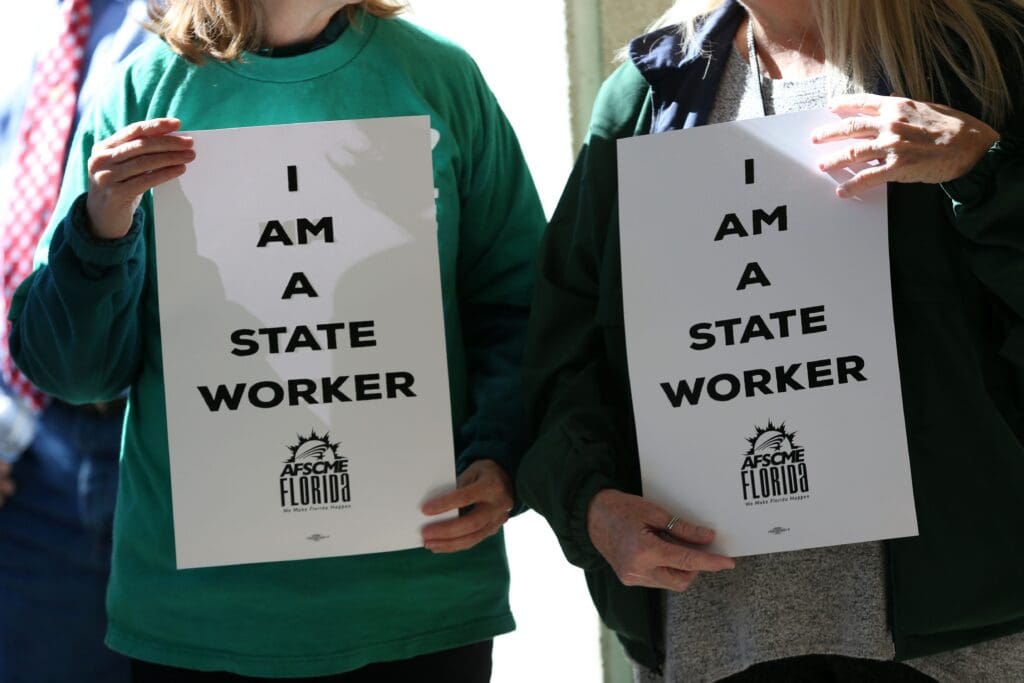
Florida state workers await decision on pay raises
The question of whether there will be a pay raise has become a bargaining chip.
Inflation hits nearly 3-year high as gas prices spike 21% in one month
inflation climbed to its highest level in nearly three years to an annual rate of roughly 3.5%, driven by surge in gasoline prices
Scripps News
Florida lawmakers will soon debate whether to give state employees a pay raise in the upcoming budget.
Gov. Ron DeSantis, the House and the Senate have all different ideas on how to do it.
Deliberations are complicated by a forecasted drop in state revenue and rising costs for things like health insurance.
When Florida lawmakers return to Tallahassee on May 12, they will address the question being asked by nearly 100,000 state employees:
Are there pay raises coming in next year’s state budget?
Gov. Ron DeSantis started the debate in December with his budget proposal that called for a 2% across‑the‑board raise for state workers, along with anadditional 3% for law enforcement and corrections officers.
The price tag for such a boost is roughly $168 million in general revenue, or well under 1% of Florida’s annual budget of more than $117 billion.
Now, as House and Senate negotiators reopen talks on the 2026‑27 spending plan, neither chamber has picked up the governor’s proposal.
Because the Florida Constitution requires a balanced state budget to be in place by July 1, lawmakers must return in a special session after they failed to reach agreement during the regular session amid unresolved differences over how much to spend, how big tax cuts should be, and other budget priorities.
The question of whether there will be a pay raise has become a bargaining chip amidst plenty of other priorities in negotiations for the yearly spending blueprint.
Budget writers must balance an expected drop in sales tax collections with fixed increased costs, such as energy to light and air-condition state offices and subsidize health insurance premiums for workers.
How lawmakers balance competing state budget priorities
Here’s the situation as lawmakers gather in Tallahassee to write a budget before the next fiscal year starts on July 1:
The Senate proposed a 3% raise for all state workers, with a guaranteed minimum increase of $1,000, and an additional 2% bump for law enforcement, corrections officers, firefighters and other hard‑to‑fill public safety jobs.
The House did not include an across‑the‑board raise but offered to freeze employee health‑insurance premium costs.
The governor’s office has gone quiet. Asked recently whether DeSantis still supports a 2% increase for rank-and-file employees, a spokesperson said, “Stay tuned.”
Keep in mind budget proposals are starting positions, and lawmakers will begin cutting deals with employee compensation on the table near the end of negotiations.
Leon County lawmakers will watch budget talks closely
For Tallahassee‑area legislators, the issue hits close to home: There are roughly 23,000 state employees staffing agencies, prisons, and offices across a three-county capital region. That’s about a quarter of the total state workforce of roughly 98,000, according to the Florida Department of Management Services.
Rep. Allison Tant, D‑Tallahassee, said Leon County’s four‑member legislative delegation is working in coordination to have an across-the-board raise included in the budget. “But understand that negotiations are just beginning,” Tant said when asked for details.
Tant and Reps. Jason Shoaf, R-Port St. Joe, and Gallop Franklin, D-Tallahassee, and Sen. Corey Simon, R-Tallahassee, are state workers’ top advocates at the Capitol. With nothing yet locked in, the outcome will largely depend on the leverage their votes provide in committee, along with the additional influence Shoaf and Simon can employ as committee chairs.
Shoaf heads the House Transportation & Economic Development Budget subcommittee, while Simon leads the Senate’s pre-K–12 Education Committee.
With shaky economy, Florida readies for leaner, meaner budgets
State economists warn it is time to prepare tighter budgets. They foresee reductions in consumer spending and fewer tourists traveling to Florida, translating to lower sales tax revenue, as well as a weak job market. It’s a triple threat to general revenue collections in a state dependent on sales tax.
Another wrench in lawmakers’ efforts to build a spending plan is DeSantis’ repeatedly pledging to call a special session to address property taxes. He wants a initiative on the November ballot. DeSantis has warned that if lawmakers don’t act, he could call multiple special sessions until they do.
But any serious property tax relief plan forces lawmakers to consider whether the state will replace lost local revenue so cities and counties can continue to provide core services.
The Legislature’s Office of Economic and Demographic Research, or EDR, has issued long‑range forecasts that assume costs for Medicaid, education, disaster recovery and employee benefits will outpace revenue growth.
Both EDR and Florida TaxWatch, a nonprofit think tank based in Tallahassee, warn that years of budget surpluses fueled by federal pandemic aid have ended. They add that global conflicts, particularly in the Middle East, are a wild card in calculations, possibly leading to spikes in oil prices, which reignites inflation and further undermines consumer spending.
The result is a budget process defined by tension between short‑term affordability and long‑term sustainability, and between workforce pay and fiscal restraint.
For state worker health insurance, relief comes at a price
State workers did get one measure of clarity during the break in negotiations between the March 13 end of the regular legislative session and the start of the special budget session on May 12. The Senate’s lead budget negotiator confirmed health‑insurance premiums will remain frozen for another year.
“We decided to hold steady on any increase in the health insurance, the employee cost, which is a significant number,” said Sen. Ed Hooper, R-Clearwater, chair of the Florida Senate Appropriations Committee. He added that an across‑the‑board raise remains “a discussion item.”
Covering an expected deficit in the health plan and leaving workers’ premium contributions at $50 per month for individual coverage and $180 for family plans will cost roughly $363 million. The health plan is on course to run a $1.6 billion deficit by 2030 – if changes are not made.
The potential trade-off: Using general revenue money to stabilize health insurance in the 2026-27 budget will take money that could be used to increase pay.
On pay, employee turnover and a leaner state workforce
Florida ranks at the bottom nationally in average state‑employee pay, roughly $53,620 annually, which places it alongside Arkansas and West Virginia, two states with much smaller economies and populations.
The state also operates with just 96 state employees per 10,000 residents, less than half the national average. “Employees leave state jobs because they’re not being paid enough,” Tant said.
While Tant and others argue an overstretched workforce results in chronic vacancies, unanswered calls and long waits at state agencies, others point to low employment and wages as signs of efficiency and fiscal discipline, not of neglect.
“Florida has the lowest number of government workers per capita in the country, yet we provide better services at a lower cost than any other state of comparable size,” DeSantis said last year in Tampa.
James Call is a member of the USA TODAY NETWORK-Florida Capital Bureau. He can be reached at [email protected]. Follow on X: @CallTallahassee.